
Practice EMR Match Quiz: Your Top 3 EMRs, Costs and Demo Questions
This free quiz asks ten quick questions about how your practice runs and ranks the EMRs that fit it best, whether you bill insurance, take cash, run memberships or a concierge retainer, or practice functional medicine. You'll see your top 3 with a match score and plain reasons, what each costs at its published price for your number of providers, the questions to ask on each demo, and the jobs you'd still need another tool for. It takes about two minutes, and nothing is hidden behind an email.
Loading the tool…
Opening soon or switching tools?
Book a free 20-minute stack review with the Tabflows team. We'll look at the tools you're picking or already use and map how they should connect, before opening day or before your next renewal.
How the quiz scores each EMR
Every answer moves points toward or away from specific EMRs, and that is the whole score. How your patients pay carries the most weight, because an EMR built around insurance claims and one built around monthly memberships solve different problems. A practice that mostly bills insurance earns points for athenahealth, Charm and Hero EMR, while a membership practice earns them for Hint, Atlas.md and Elation, and a concierge practice for SigmaMD and Ultralight Health.
The other answers fine-tune the ranking. Dispensing medications in house favors Atlas.md and Hint, which both list dispensing in their features. Supplements, IVs and aesthetics favor OptiMantra and Cerbo, programs and care plans favor Healthie, and specialty lab panels favor Ultralight Health and Cerbo. Needing EPCS (prescribing controlled substances electronically) adds a point to each vendor that publishes it, and if you're switching, eClinicalWorks gains points because it says it will migrate your data from your current EHR for free.
Your budget answer compares each vendor's published monthly cost per provider with the amount you chose. Inside your budget adds two points, a little over takes one away, and well over takes two. Vendors without a published price get no budget points either way, so they're never rewarded or punished for a number we don't have. Ties go to the vendor with fewer gaps, then the lower first-year cost. Open "How this adds up" under any pick to see each point next to the answer that caused it.
Where the prices come from
Every price in the quiz is the vendor's own published price, checked on each vendor's site in November 2026. The cost shown is the monthly subscription for your number of providers plus the published add-ons your answers call for, like ePrescribing, telehealth, per-claim billing and membership billing. Card processing and staff seats are left out because they depend on your volume and your team.
| EMR | Published price the quiz starts from |
|---|---|
| Elation Health | $425 per provider a month, or $375 on the Standard DPC plan |
| CharmHealth | $200 per provider a month, eRx $15, telehealth $20 |
| OptiMantra | $99 first practitioner, $49 each added, eRx with EPCS $38 |
| Cerbo | $281 per prescriber, portal $79, $1,195 one-time setup |
| Healthie | $45 or $115 a month for one clinician, billed annually |
| Atlas.md | $300 per provider, $475 eRx setup per prescriber |
| Hint | $290 a month on Launch, unlimited members |
| Akute Health | $300 with 100 patients, then $0.75 per patient |
The patient and claim answers are ranges, so the quiz uses one number for each. "About 400" patients is counted as 400, "Under 200" as 150, and "1,500 or more" as 2,000. For claims, "Under 100" counts as 50, "100 to 500" as 250, and "More than 500" as 800. Those matter only for vendors priced by patient or by claim (Akute, Healthie, Hint's Pro plan and OptiMantra's $0.25 a claim). They're typical figures, so pick the answer closest to your own.
A quote-based vendor isn't a worse vendor. athenahealth and eClinicalWorks are full systems that simply don't publish prices, so book the demo and ask for the total in writing at your size.
How to read your results
Each of your top 3 shows a match score, the monthly cost at its published price, and the plan the quiz priced. The score is only meaningful next to the other scores on your list, so a 12 against a 4 is a clear winner, while a 9 against an 8 is a coin flip you should settle on the demo.
Under each pick you'll find "Why it fits", drawn straight from what the vendor publishes, and "Worth checking", which covers caveats like Cerbo's $63 a month per staff user or Atlas.md's $400 yearly eRx renewal from year two. The amber box lists the gaps, meaning jobs your answers need that the vendor doesn't publish as part of its product. A membership practice looking at athenahealth, for example, will see membership billing as a gap, along with a note that Hint sells billing on its own beside another EHR.
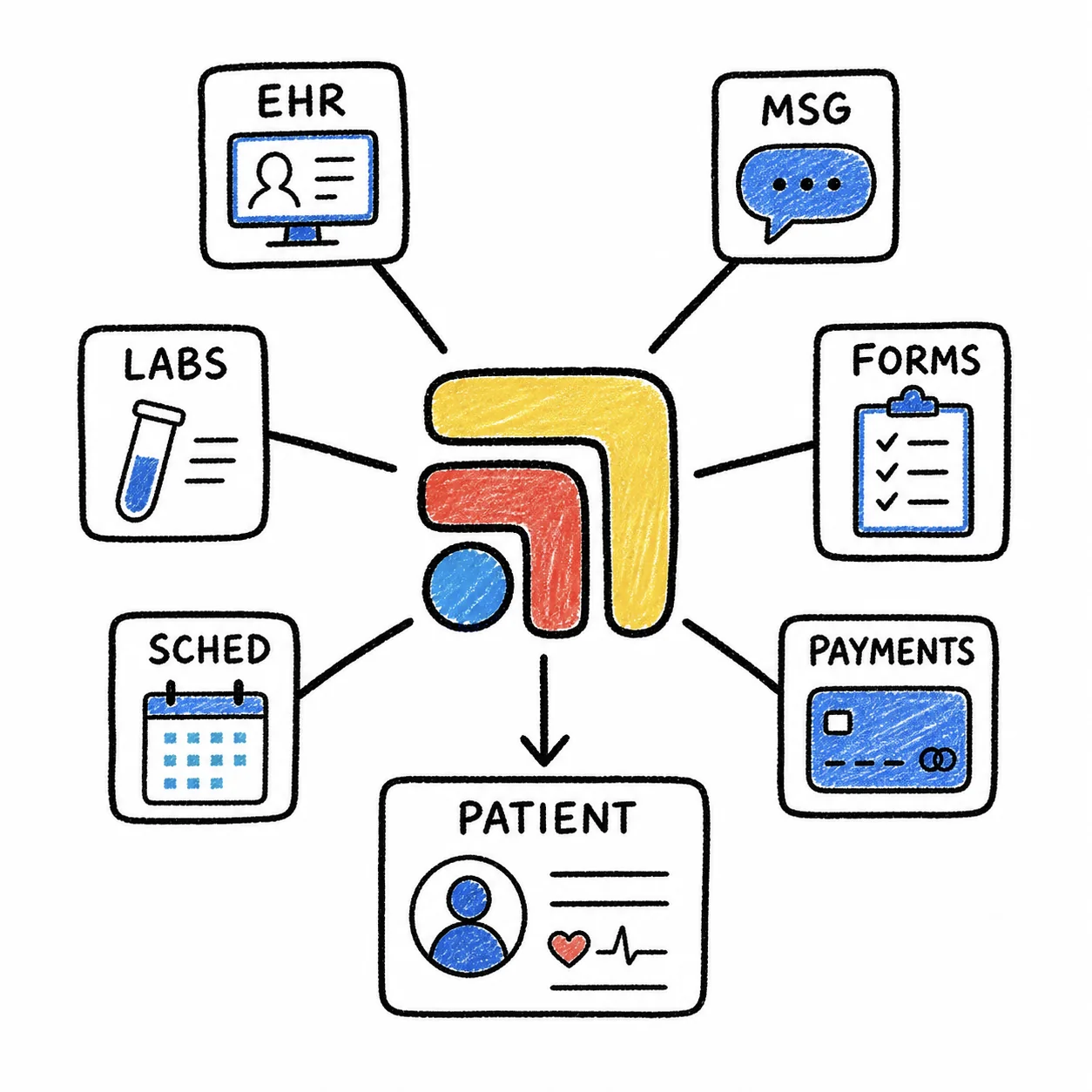
Gaps matter more than most people expect. Each one means a separate tool, and those tools were never built to talk to each other, so someone on your team ends up copying names, payments and results from one screen to the next. When two vendors score close together, the one with fewer gaps usually saves more time than the one with the lower sticker price.
What to do with your top 3
Book a demo with each of your three, and send your numbers ahead of time so the quote matches your practice. Bring the questions the quiz wrote for each vendor, plus one ordinary day from your own practice (a visit, a refill, a lab and a payment) and ask each vendor to run that same day live. Our guide on how to choose medical practice software walks through running a fair demo.
Then add up the whole picture. The EMR is usually the biggest line, but phones, scheduling, forms, fax and payments all add to the monthly bill, and the medical practice software cost calculator prices those alongside your EMR. If you'd like more context on the vendors themselves, the best EMR for a small practice and best EMR for a private practice guides compare them in depth.
If you want everything on one page, enter your email under the results. You'll get a printable shortlist with your answers, the cost math for each pick, every demo question as a checklist, and a dated three-week plan from booking demos to comparing written quotes.
The part most guides skip
Every tool in a DPC clinic is good at its own job, and none of them were built to talk to each other. A patient text turns into a refill in the chart, which needs a review, which needs a reply, and the follow-up lives in someone's head. That isn't anyone's fault. The tools just don't share a to-do list.
That's the job Tabflows does. Tabflows is a dedicated tech team for DPC clinics. We connect the tools you already chose and give your team one place for chat, tasks and patient context, with managed workflows for the repeat work like refills, lab follow-ups and onboarding. You keep every tool you picked.
Frequently asked questions
Which EMR is best for a small private practice?
It depends most on how your patients pay. Practices that mostly bill insurance tend to match athenahealth, Charm or Hero EMR, membership and DPC practices tend to match Hint, Atlas.md or Elation, and cash-pay functional practices tend to match OptiMantra or Cerbo. The quiz weighs those trade-offs against your size, budget and special needs.
How does the practice EMR quiz score each vendor?
Each answer adds or takes away points for specific EMRs, and every point is tied to something the vendor publishes on its own site, checked in November 2026. Open "How this adds up" under any result to see each point and the cost math.
Why do some EMRs show as quote-based?
athenahealth, eClinicalWorks, Hero EMR, SigmaMD, Jane, Ultralight Health and Epic don't publish a price on their sites. The quiz can still rank them on fit, but it leaves them out of every cost comparison rather than guessing.
Is Epic an option for a small practice?
Rarely on its own. Epic's Garden Plot program for independent groups is for groups with more than 40 providers, so a small practice usually reaches Epic only through a nearby health system's Community Connect program. The quiz scores it last for that reason.
Does the quiz cost anything or need my email?
No. Your top 3, the costs and the demo questions show on the page as you answer. Your email is only needed if you want the printable shortlist with a dated three-week plan.