
What Medical Practice Software Costs: A Whole Stack, Priced
A small medical practice can run its whole software stack (EMR, phones and texting, scheduling, intake forms, fax and an ambient scribe) for about $130 a month if it picks the lowest-cost published plans, or about $770 a month on a more typical set of tools for one doctor and one staff member. A three-provider practice runs from about $590 to $2,085 a month. Card processing comes on top, and for a cash-pay or membership practice it is often the single largest line.
Every price below is a published price from the vendor's own site, checked in November 2026. Where a vendor doesn't publish a number, we say so instead of guessing. Prices change, so use these totals to set a budget and then confirm each line on your demo calls.
How we built these totals
A software budget only means something when you know what's in it, so here are the assumptions behind every table on this page.
- Solo practice means one doctor plus one staff member who answers phones and handles paperwork.
- Three-provider practice means three prescribing clinicians plus two front-office staff, so five people log in.
- Annual billing is used wherever a vendor shows a lower annual price, because most small practices take it once they've settled on a tool.
- Card fees are kept separate, since they scale with what you collect rather than with headcount. We price them in their own section.
- Sales tax and telecom fees are left out. Spruce, for example, notes that its invoice adds sales and telecommunication taxes.
The "lower-cost" column uses the cheapest published plan that can do the job. The "typical" column uses tools a busy practice tends to grow into. Neither is a recommendation for your practice, and the right mix depends on how you get paid, which we cover in how to choose medical practice software.
The published price of each job
Here is what each job costs on its own, from published prices.
| Job | Lower-cost option | Typical option |
|---|---|---|
| EMR, solo | Charm free plan + $15/mo eRx | Elation Standard Provider, $425/mo |
| EMR, per extra clinician | OptiMantra, $49/mo | Elation, $425/mo |
| Phones and texting | Spruce Basic, $24/mo per user | Spruce Communicator, $49/mo per user |
| Scheduling | Cal.com Teams, $12/mo per user | Acuity Premium, $55/mo |
| Intake forms | PracticeQ Forms Only (low volume), $29.90/mo | PracticeQ Forms Only, $54.90/mo |
| Fax | Documo Solo, $25/mo | Documo Business, $100/mo |
| Ambient scribe | Heidi Free, $0 | Heidi Clinician, $110/mo per user |
A few notes behind the menu. Elation's Standard Provider plan includes office staff and ePrescribing for controlled and non-controlled drugs, which is why its sticker price absorbs costs that cheaper EMRs bill separately. Charm's free plan is real but small, with one provider, 50 encounters a month and a 100-patient portal. Elation also lists scribing inside its encounter workflow among its included features, so many doctors on Elation could drop the separate scribe line entirely, and we've kept it in the typical stack only for doctors who prefer a standalone scribe's notes.
A solo practice stack, priced
Here is the math for one doctor and one staff member. Spruce counts every teammate as a user, so the phone line is priced for two people.
| Job | Lower-cost stack | Typical stack |
|---|---|---|
| EMR | Charm free + eRx = $15 | Elation = $425 |
| Phones and texting | Spruce Basic, 2 × $24 = $48 | Spruce Communicator, 2 × $49 = $98 |
| Scheduling | Cal.com, 1 × $12 = $12 | Acuity Premium = $55 |
| Forms | PracticeQ low volume = $29.90 | PracticeQ Forms Only = $54.90 |
| Fax | Documo Solo = $25 | Documo Solo = $25 |
| Scribe | Heidi Free = $0 | Heidi Clinician = $110 |
| Monthly total | $129.90 | $767.90 |
| Yearly total | $1,558.80 | $9,214.80 |
The lower-cost stack has limits you should go in with eyes open. PracticeQ's low-volume forms plan is capped at 10 submissions a month, and Charm's free plan stops at 50 encounters. A doctor seeing patients full time will outgrow both, and Charm's next step (its encounter plan) is $0.50 per encounter with a $25 monthly minimum, so 300 encounters would add $150 a month. For a deeper look at the EMR choice on its own, see the best EMR for a solo practice.
A three-provider practice stack, priced
With three clinicians and two staff, per-seat pricing starts to matter more than any single plan.
| Job | Lower-cost stack | Typical stack |
|---|---|---|
| EMR | OptiMantra $99 + 2 × $49 = $197 | Elation, 3 × $425 = $1,275 |
| ePrescribing | OptiMantra eRx with EPCS, 3 × $38 = $114 | Included |
| Phones and texting | Spruce Basic, 5 × $24 = $120 | Spruce Communicator, 5 × $49 = $245 |
| Scheduling | Cal.com, 3 × $12 = $36 | Cal.com, 3 × $12 = $36 |
| Forms | PracticeQ $54.90 + 2 × $20 = $94.90 | Jotform Gold = $99 |
| Fax | Documo Solo $25 + 2 × $3 users = $31 | Documo Business = $100 |
| Scribe | Heidi Free = $0 | Heidi Clinician, 3 × $110 = $330 |
| Monthly total | $592.90 | $2,085 |
| Per clinician | $197.63 | $695 |
| Yearly total | $7,114.80 | $25,020 |
OptiMantra keeps the low stack cheap because clerical staff are free and extra practitioners are $49 a month, though clinical staff are $25 a month each and its eRx license with EPCS is $38 a month. We assumed one eRx license per prescriber, which is worth confirming on the demo. Scheduling barely moves between the two columns because good scheduling is inexpensive, while the EMR and the scribe drive almost all of the difference.
Card fees, the line that grows with you
Payment processing isn't a subscription, but for a cash-pay, concierge or membership practice it can be larger than the software bill itself. Here is one example month, with 200 card payments of $100 each ($20,000 collected).
| Processor | Published card rate | Fee per $100 | Fees on 200 payments |
|---|---|---|---|
| Atlas.md (built into the EMR) | 2.1% + 30¢ | $2.40 | $480 |
| Stripe | 2.9% + 30¢ | $3.20 | $640 |
| Square, card on file | 3.5% + 15¢ | $3.65 | $730 |
| Stripe ACH Direct Debit | 0.8%, $5 cap | $0.80 | $160 |
Two things jump out. The gap between processors on the same $20,000 is $250 a month, or $3,000 a year. And moving recurring payments from cards to bank debit cuts the fee by a large margin, which matters most for memberships that charge the same patients every month. Disputes cost extra too, at $15 each on Stripe and $15 plus the original processing fee on Atlas.md. Our patient payments and billing guide goes further into memberships, superbills and payment plans.
Ask every EMR vendor whether you must use its built-in processor. Some membership features require a specific one (Elation's Membership Management requires a Stripe account), which can decide your card rate for years.
The hidden costs that don't show on the pricing page
Monthly plan prices are the easy part. These are the costs that tend to surprise a practice in its first year.
Setup and onboarding fees
Cerbo charges a $1,195 one-time setup fee, or $595 under its new-practice special for part-time solo practices with fewer than 30 patients and less than six months in business. Hint charges $500 for paid onboarding, which its Scale plan requires. Spruce charges a one-time $19.50 to turn on outbound texting.
ePrescribing and controlled substances
Some EMRs include ePrescribing and some bill for it on its own. Atlas.md publishes a $475 setup fee per prescriber, a $400 annual renewal per prescriber, and a $525 PDMP setup fee per clinic. Akute lists EPCS as an extra $15 a month, Charm's eRx add-on is $15 per provider each month, and OptiMantra's is $38. Over a year, this line alone can change which EMR is actually cheapest.
Per-seat creep
Every hire changes the bill, but differently in each tool. Spruce counts every teammate as a user and requires the whole organization to be on the same plan. Cerbo charges $63 a month for each additional full-time staff member, while Elation includes office staff and OptiMantra doesn't charge for clerical staff. Before you hire a second front-desk person, it's worth tallying what that seat costs across every tool they'll log into.
Usage overages and add-ons
Documo's Solo plan charges $0.15 for each page over its allowance, and Elation charges $0.07 a page past its free monthly fax allotment. Cerbo lists its patient portal at $79 a month and telemedicine at $27 per provider. Spruce charges $100 a month for CSV data export, and Hint's API is a $100-a-month add-on, both of which matter if you ever want your data somewhere else.
Staff time between tools
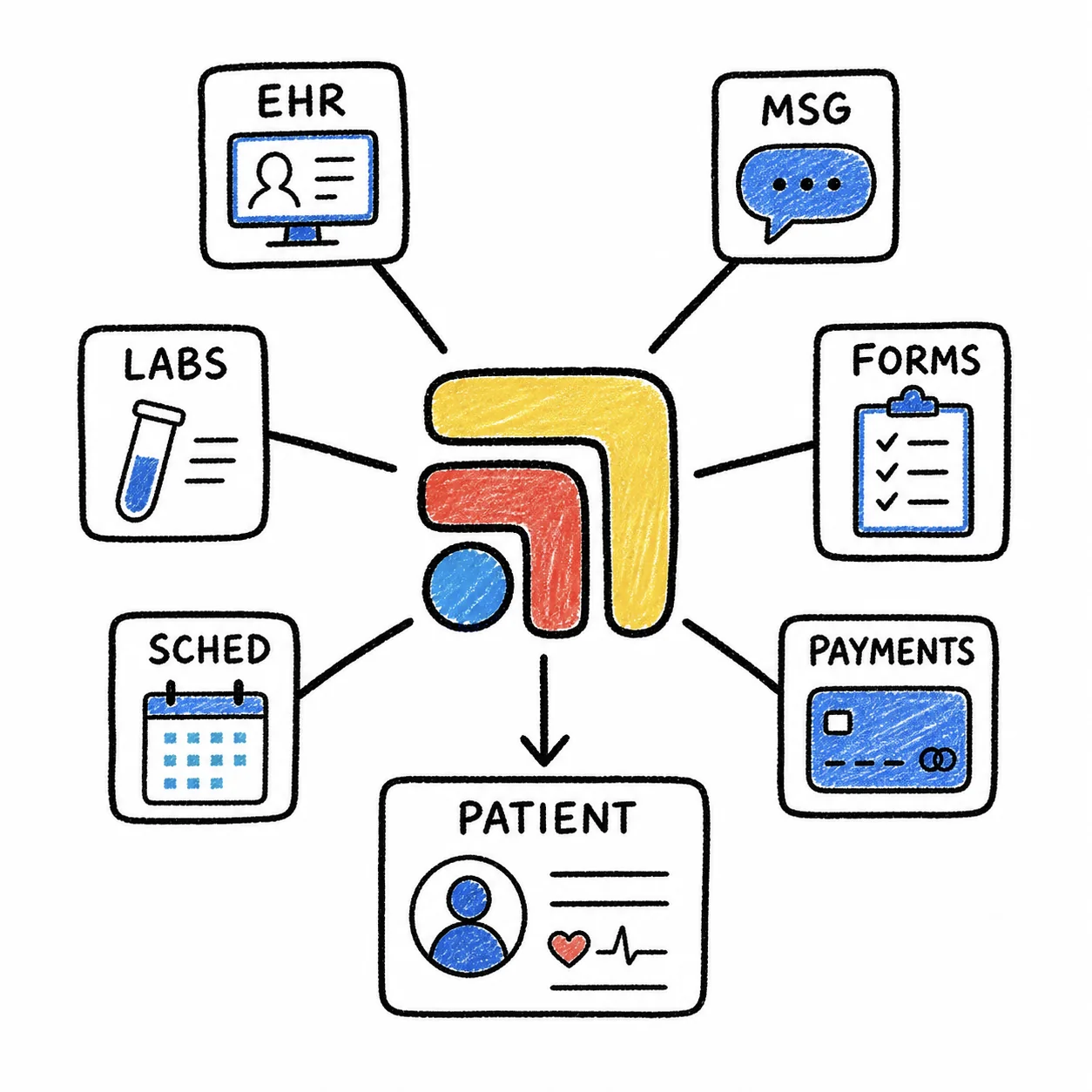
The cost no vendor quotes is the time your team spends carrying information from one tool to the next. When phone messages, intake answers and faxes land in three separate systems, someone has to retype or attach each one to the chart, because the tools were never built to share data with each other. If that takes 30 minutes a day, it adds up to about 10 hours a month over 20 working days, which is real payroll and real delay for patients. This is also where Tabflows works, as a dedicated tech team that connects the tools a practice already uses so those handoffs happen on their own.
Ways to keep the total down
The cheapest stack isn't always the cheapest year. Before comparing, check what your EMR already includes (fax, a scribe or online booking can make a standalone tool unnecessary), add setup fees and eRx renewals to the yearly total, and ask every vendor in writing who counts as a seat.
If you're still choosing the core system, our guide to the best EMR for a small practice compares the main options side by side, and the setup checklist for a new practice shows what to buy first when you're opening.
The part most guides skip
Every tool in a DPC clinic is good at its own job, and none of them were built to talk to each other. A patient text turns into a refill in the chart, which needs a review, which needs a reply, and the follow-up lives in someone's head. That isn't anyone's fault. The tools just don't share a to-do list.
That's the job Tabflows does. Tabflows is a dedicated tech team for DPC clinics. We connect the tools you already chose and give your team one place for chat, tasks and patient context, with managed workflows for the repeat work like refills, lab follow-ups and onboarding. You keep every tool you picked.
Frequently asked questions
How much does medical practice software cost per month?
Using published prices from November 2026, a solo practice can run an EMR, phones, scheduling, forms, fax and a scribe for about $130 a month on lower-cost tools, or about $770 a month on a typical stack. A three-provider practice lands between roughly $590 and $2,085 a month, before card fees.
What is the biggest hidden cost in practice software?
For most cash-pay and membership practices it's card processing, which is a percentage of everything you collect and can rival the whole software bill. After that come one-time setup fees, ePrescribing setup and renewals, and the staff time spent moving information between tools that don't share data.
Is free EMR software good enough for a small practice?
It can be for a part-time or brand-new practice. Charm's free plan covers one provider and 50 encounters a month, so a full-time doctor will usually move to a paid plan within the first few months.
Do I pay for software per provider or per user?
It depends on the tool. EMRs usually charge per provider, while phone tools like Spruce count every teammate as a user, so your front desk adds to that bill. Ask each vendor exactly who counts as a seat.